Vilnius: Between History, Resilience and European Responsibility
A diverse group of graduates and students from a wide range of disciplines explored the Lithuanian capital – politically, culturally and socially.
COUNTRY & CITY AT A GLANCE
| 3 Mio. inhabitants | 2004 EU and NATO accession | 2015 Introduction of the euro | 7 % of the population of Russian descent |
Lithuania surprises with a remarkable linguistic feature: Lithuanian is considered the oldest living European language and, of all modern languages, comes closest to reconstructed Proto-Indo-European, a living testimony to cultural continuity spanning millennia. The country’s cuisine reflects its Northern European character: potatoes form the solid base of many main dishes. The openness and warmth of our Lithuanian counterparts shaped the entire trip and made the professional exchange especially rewarding.
VISIT 1
Delfi News – Media Freedom in the Hybrid Age
We kicked off with a visit to Delfi, the leading Baltic news portal, which is financed mainly through advertising. The group was given a tour of the studio and the editorial offices and experienced firsthand how independent journalism works in a geopolitically sensitive environment.
In a conversation with a young journalist, it became clear how important dealing with disinformation and Russian propaganda is in everyday newsroom work. Hybrid warfare, in particular the targeted use of supposed journalists as instruments of state influence, is no longer a theoretical concept but lived reality. The EU, NATO and Germany are seen as reliable partners: the presence of German soldiers in the city gives the population a genuine sense of security. The visit ended with a view of the rainy but impressive city skyline from the rooftop.
VISIT 2
City Tour of Vilnius – Memory, Legend and Identity
The group owes numerous insights into Vilnius’ multilayered history to the city tour. The city’s name derives from the river Vilnia, and the legend of the Iron Wolf, a dream of Grand Duke Gediminas, marks the mythical founding story of the capital.
The historical wounds run deep: under Soviet occupation, hundreds of thousands of Lithuanians were deported, imprisoned or persecuted by Stalin, a chapter that is remembered in the collective memory as even more severe than Nazi rule. Under the Nazis, more than 90 percent of the former Jewish quarter was wiped out. Today, Lithuania is a firmly rooted Catholic country that has redefined its identity on the basis of this difficult legacy.
VISIT 3
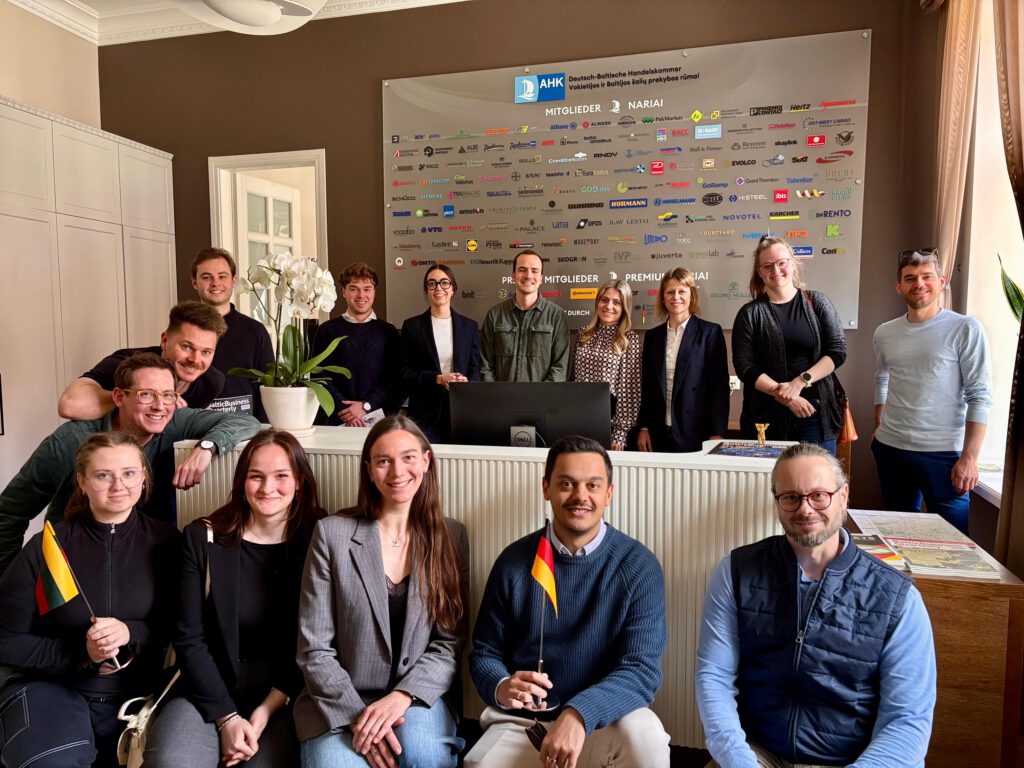
German-Baltic Chamber of Commerce – Economic Bridge to the East
The German-Baltic Chamber of Commerce gave a structured overview of the economic relations between Germany and the Baltic states. Of particular interest was the markedly increased engagement of German companies in the region; investments by Rheinmetall, for example, underline the growing importance of the Baltics for security policy. The Chamber plays an important bridging role here: it promotes exchange and makes it easier for German companies to enter the market.
VISIT 4
UNHCR – Humanitarian Action Under Pressure
The meeting at the UNHCR office in Vilnius gave a sober picture of the current situation: the withdrawal of the USA from its international funding responsibility, most recently a cut of around 40 percent in the US contribution, has led to considerable job cuts. The organization is responding by consistently prioritizing its areas of work and by using its resources deliberately. The message was clear: humanitarian commitment requires reliable international solidarity.
VISIT 5
Goethe-Institut Vilnius – Cultural Diplomacy on the Ground
The Goethe-Institut Vilnius offered a lively insight into the diverse work of German foreign cultural policy. Far beyond the classic range of language courses, the institute is involved in early childhood cultural education and in intercultural dialogue. The impressive exterior architecture with its picturesque balcony views left a lasting impression, a place that makes openness and cultural encounter visible.
VISIT 6
CPVA – Innovation as State Strategy
The International Partnership Center (CPVA) presented an impressive range of funding projects, all of which show a high degree of creative courage. A particular highlight was the Create Lithuania program: returnees from the diaspora get the opportunity to spend a year working on two concrete projects for the structural development of the country. One project that emerged from it is dedicated to recycling plastic bottles, practical, measurable, effective. The model has meanwhile been transferred to war-torn Ukraine as Create Ukraine, to give young people there prospects of shaping the future despite all adversity.
Another highlight was a competition procedure for modular school buildings, which is intended to significantly speed up the reconstruction of educational infrastructure, massively affected by COVID and the consequences of war. The approach combines architectural efficiency with social urgency.
VISIT 7
Freedom Center – Resilience as a Societal Task
The most content-rich conclusion of the official program was the visit to the Freedom Center of the Friedrich Naumann Foundation. The presentation on hybrid warfare was as enlightening as it was unsettling: a vivid example was balloons loaded with tobacco from Belarus, which, depending on wind conditions, make it necessary to close the airspace at Vilnius Airport, a low-threshold but effective means of destabilization.
A civil defense structure with around 20,000 volunteers was also presented. As part of basic training, they acquire a wide range of skills, including piloting drones, which the group was able to try out for itself on a demonstrator on site. Germany is highly regarded here as well; the gratitude toward German soldiers is sincere and heartfelt.
The Center’s central concern is building societal resilience as a whole, a process that has to start with children. Dealing with threat scenarios has by now become part of general education in Lithuania.
CONCLUSION
More Than a Program – a True COH Experience
| Vilnius inspired us, a diverse group of graduates and students from a wide range of disciplines, on many levels. The encounters with journalists, diplomats, cultural professionals and civil society actors showed how a small country on NATO’s eastern flank asserts its place in Europe with determination, a spirit of innovation and a clear moral compass. Particularly remarkable was the consistently positive perception of Germany and the great appreciation for German engagement in Lithuania. But as befits a study trip in the usual COH manner, it was not just about appointments and meeting rooms: the lively conversations about politics, history and culture between the program items and at the shared dinner were at least as valuable as the official meetings. Hardly any other city combines historical depth and modern dynamism as naturally as Vilnius. Exploring Vilnius on foot, as Europe’s greenest city, it practically invites you to do so with its charming old town, was a delight for all the senses. And because a COH trip would be incomplete without unforgettable evenings: at the karaoke night, which has by now become a fixed part of the program, some participants impressively demonstrated their singing skills. Whether the microphone was always in the right hands is something the group politely keeps quiet about. A trip that makes you curious, gives you food for thought, and makes you look forward to the next COH study trip. |